"Knowledge graph" sounds like something only data scientists need to understand. It isn't. The idea is simple, you already use one every day, and it is becoming one of the most important foundations for AI that businesses can actually trust.
Start with how you'd explain your business to a new colleague
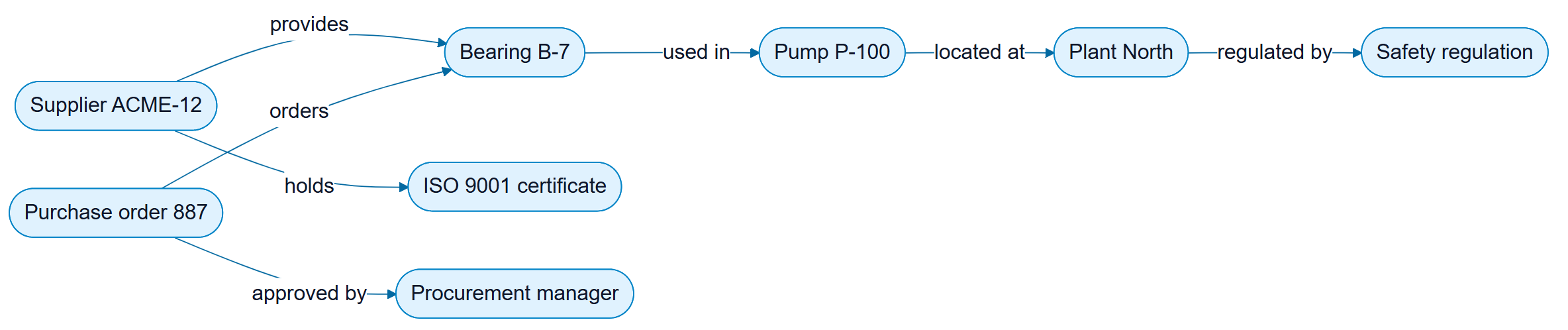
Imagine explaining your procurement process to someone on their first day. You wouldn't hand them a spreadsheet. You'd say something like:
- "This supplier provides these parts."
- "Those parts go into this pump."
- "That pump sits in this plant, which is covered by this safety regulation."
- "Any order over this amount needs approval from that manager."
Every sentence connects one thing to another thing through a relationship. That is all a knowledge graph is: a collection of things (people, suppliers, assets, contracts, regulations) and the relationships between them, stored in a way a computer can follow.
In graph terms, the things are nodes and the relationships are edges. Draw them on a whiteboard and you get a network of circles and arrows. That picture is the graph.
You already use one
When you search for a famous person and a panel appears beside the results with their birthplace, spouse, films and awards, that panel comes from a knowledge graph. Social networks are graphs of people and friendships. Online maps are graphs of places and roads. Graphs are everywhere because the real world is made of connected things.
Why not just use a spreadsheet or a normal database?
Spreadsheets and traditional databases store information in tables: rows and columns. They are excellent for lists of transactions, customers or invoices. They are much worse at connections, especially long chains of them.
Take a simple question: "If this supplier goes out of business, which of our plants are affected, and which of those are covered by safety regulations that require a backup supplier?"
In tables, answering that means joining many tables together, often across several systems, and someone has to know exactly how they fit. In a knowledge graph, it's a walk: start at the supplier, follow "provides" to parts, "used in" to equipment, "located at" to plants, "regulated by" to rules. The question follows the connections the same way you would think about it.
That matters in exactly the places businesses struggle most:
- Impact analysis: what does this change, failure or delay affect?
- Root cause: what upstream problem explains all these downstream alarms?
- Compliance: does this decision touch any rule that applies?
Where the data lives: you don't have to move it
A common worry is that building a knowledge graph means copying all your data into a new system. It doesn't have to. A knowledge graph can describe how your existing systems relate to each other (your ERP, maintenance system, document store) and fetch the actual data from those systems when it's needed. The graph becomes a map that connects your data rather than another place to store it.
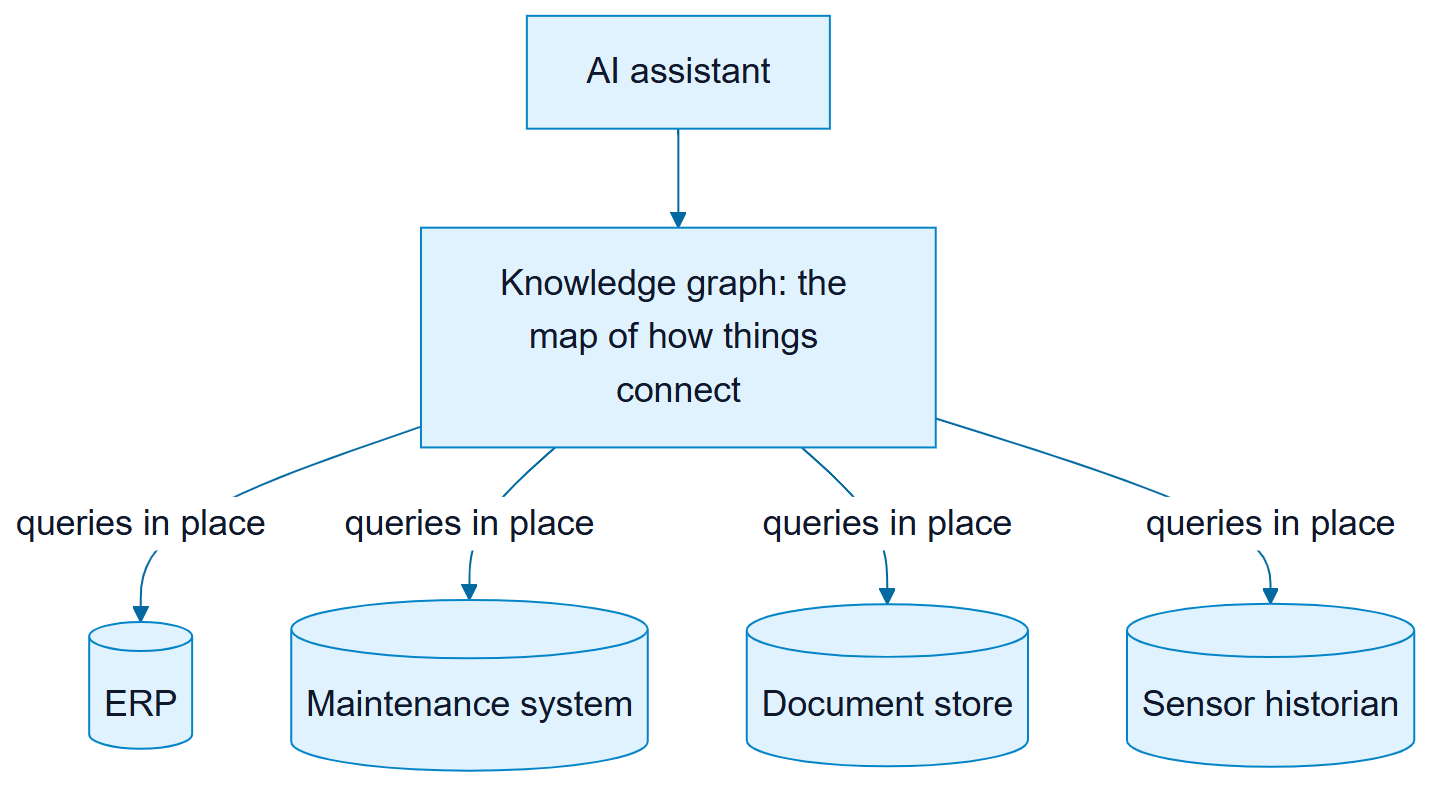
For regulated organisations with strict rules about where data can live, this is often what makes the project possible at all.
Why knowledge graphs matter for AI
AI language models are very good with language and surprisingly poor with facts and relationships. They don't reliably know that your supplier ACME-12 is not the same as ACME-07, that a contract clause was replaced by an amendment, or that a certain approval limit applies only to capital spending.
A knowledge graph gives AI something solid to stand on:
- Facts, not guesses. The AI can look up the actual relationship ("Is this supplier approved for this category?") instead of inferring it from text.
- Context that follows the connections. Instead of retrieving paragraphs that look similar to the question, the AI can follow the relationships that actually apply.
- Answers you can trace. Because every fact in the graph has a source, an answer built on the graph can show exactly where it came from.
Graphs, ontologies and rules: how they fit together
A knowledge graph on its own is a map of facts. To make AI follow your rules, you add one more layer: an ontology, which defines what the things in the graph mean and what rules govern them. For example, "every purchase order must have exactly one approved supplier", or "a certificate is only valid before its expiry date". With that layer, software can not only look things up but also check whether a proposed decision is allowed. We explain the difference in Ontologies and Semantic Layers, Explained Without the Jargon.
Do I need a special database?
Knowledge graphs are usually stored in a graph database, built to store and follow connections efficiently. The best-known options include Amazon Neptune, Ontotext GraphDB and Neo4j. Each has different strengths, and the right one depends on your cloud, your team and how standards-based your approach needs to be. We compare them in Neptune, GraphDB or Neo4j: How to Choose a Graph Database.
The short version
- A knowledge graph stores things and the relationships between them, the way people naturally describe a business.
- It's far better than tables at questions that follow chains of connections: impact, root cause, compliance.
- It can connect your existing systems without moving their data.
- For AI, it replaces guesses with facts and makes answers traceable.
If you're wondering what a knowledge graph of your own processes would reveal, the Archisus Business DNA Audit maps one domain in two weeks, including the connections and contradictions nobody had written down.