Once you decide to build a knowledge graph, the next question usually comes quickly: which graph database should we use? Three names come up most often in enterprise projects: Amazon Neptune, Ontotext GraphDB and Neo4j. All three are mature and widely used. They are also quite different, and the right choice depends more on your situation than on which one is "best".
This guide explains the differences in plain terms. Product features change, so check each vendor's current documentation before deciding.
First, the one big difference: two styles of graph
Graph databases come in two main styles, and it helps to know which is which.
1. RDF graphs (the "standards" style). Everything is stored as simple three-part statements: Supplier ACME-12 → provides → Pump P-100. Every thing and relationship gets a unique web-style identifier, so data from different sources can be combined without confusion. RDF comes with a family of open standards: SPARQL for querying, OWL for describing meaning (ontologies) and SHACL for rules and validation. This style is strong when meaning, rules and data integration matter most.
2. Property graphs (the "developer" style). Things and relationships can carry their own properties directly, such as Pump P-100 (installed: 2019, pressure limit: 40 bar). The model is intuitive and fast to build with, and it's popular for applications and analytics. The common query language is Cypher (and its open variant, openCypher), with Gremlin as an alternative.
The same fact in both styles:

Neither style is better overall. They suit different jobs, and some products support both.
The three options at a glance
| Amazon Neptune | Ontotext GraphDB | Neo4j | |
|---|---|---|---|
| Graph style | Both: RDF and property graph | RDF | Property graph |
| Query languages | SPARQL, openCypher, Gremlin | SPARQL | Cypher |
| Built-in reasoning (inference) | No: it stores and queries, but doesn't infer new facts by itself | Yes: rule-based inference over RDF and OWL profiles | Limited: available through extensions |
| SHACL validation | Not built in | Built in | Through the neosemantics (n10s) extension |
| Where it runs | Fully managed service on AWS | Your own servers or any cloud, or managed by the vendor | Your own servers, any cloud, or Neo4j's managed cloud (Aura) |
| Best known for | Low-maintenance operation inside AWS | Standards, semantics and reasoning | Developer experience, ecosystem and graph analytics |
Amazon Neptune
What it is: Amazon's fully managed graph database. AWS runs the servers, backups, patching and scaling.
Where it shines
- You already run most of your systems on AWS and want the graph in the same place, under the same security and compliance controls.
- You want minimal operational work.
- You need flexibility: Neptune supports both the RDF and property-graph styles.
Things to know
- It stores and queries graphs very well, but it doesn't perform OWL reasoning or SHACL validation by itself. If you need those, they run in a separate layer on top.
- It runs only on AWS, so check that the AWS regions available to you meet your data-residency requirements.
Ontotext GraphDB
What it is: an RDF database built around semantic standards, with reasoning built in.
Where it shines
- Your project is ontology-led, and you want the database itself to understand OWL and apply rules.
- You need SHACL validation close to the data.
- You need to run on your own infrastructure or in a specific country or private cloud, which is common in government, defence, energy and healthcare.
- You're combining data from many sources and want standard identifiers to keep it consistent.
Things to know
- RDF and SPARQL have a learning curve for teams used to SQL or property graphs.
- Its built-in reasoning is powerful but needs careful design on very large datasets, as with any reasoner.
Neo4j
What it is: the most widely used property-graph database, with a large developer community.
Where it shines
- Your team wants to build quickly with an intuitive model and a readable query language (Cypher).
- You need graph analytics, such as finding communities, central nodes or shortest paths, with a mature algorithms library.
- You value a big ecosystem of tools, training and people who already know it.
Things to know
- It's not natively RDF. The neosemantics (n10s) extension imports and exports RDF, maps ontologies and adds validation, which bridges much of the gap.
- Formal ontology reasoning isn't its core strength. If OWL rules are central to your project, plan where that reasoning will run.
How to choose: five questions
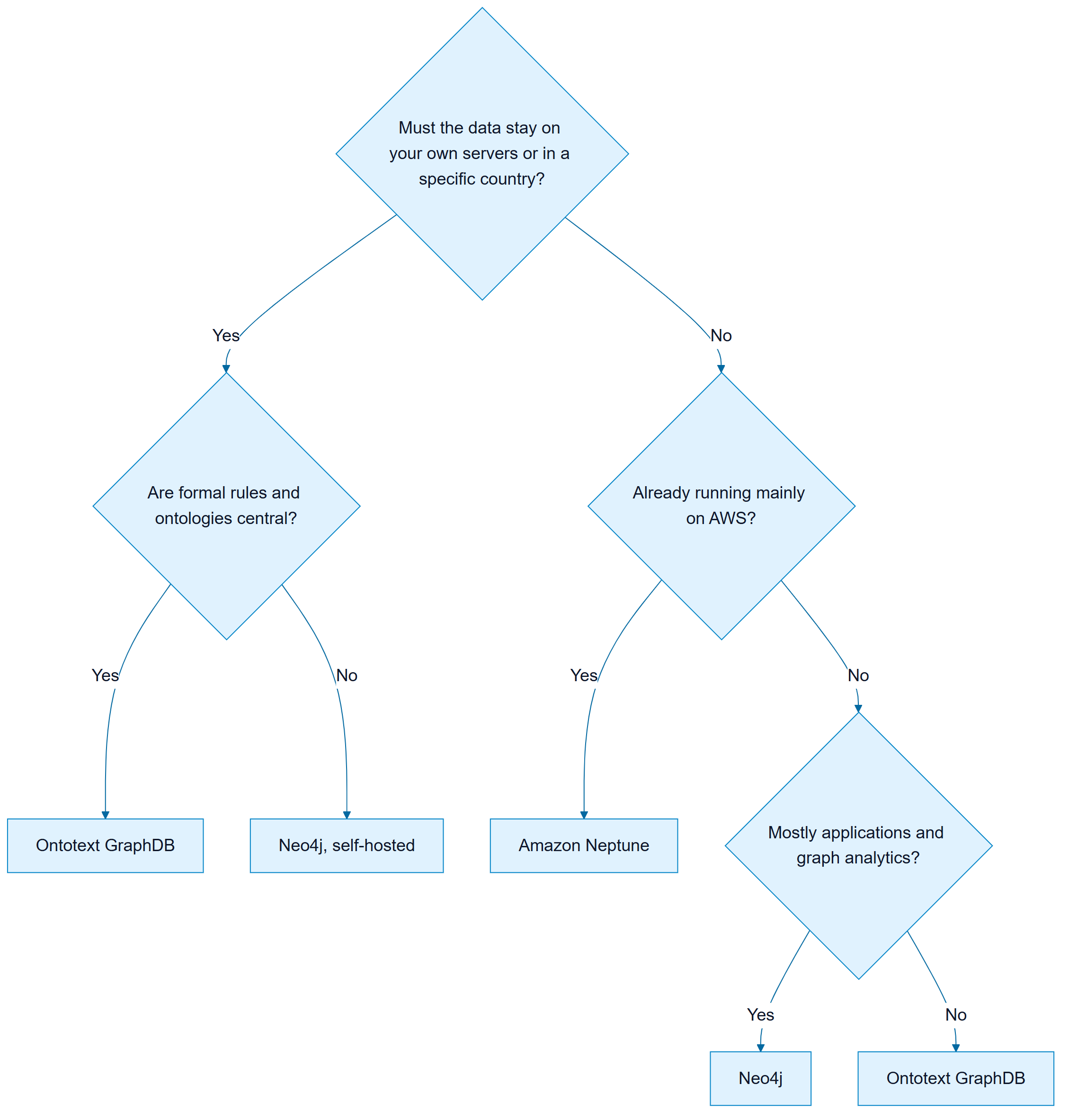
- Where must the data live? If it has to stay on your own servers or in a particular country, prefer options you can host yourself (GraphDB, Neo4j) or confirm that a suitable AWS region exists for Neptune.
- What's your cloud today? If you're already deeply invested in AWS, Neptune keeps things simple operationally.
- How central are formal rules and meaning? If the project is about rules, compliance and integrating many data sources with shared definitions, the RDF style, and GraphDB in particular, fits naturally.
- Who will build and maintain it? A team of application developers is often more productive with Neo4j and Cypher; a team with semantic-web skills will be at home with SPARQL and GraphDB.
- Is it mostly applications and analytics, or mostly governance? Fraud networks, recommendations and graph algorithms lean towards Neo4j. Compliance, policy and regulatory reasoning lean towards RDF.
A starting point, not a rule:
Does the choice lock you in?
Less than you might think. The most valuable part of a knowledge graph is not the database. It's the model: the ontology describing your business and its rules. If that model is built on open standards, it can move between stores, and the data can be exported and re-imported.
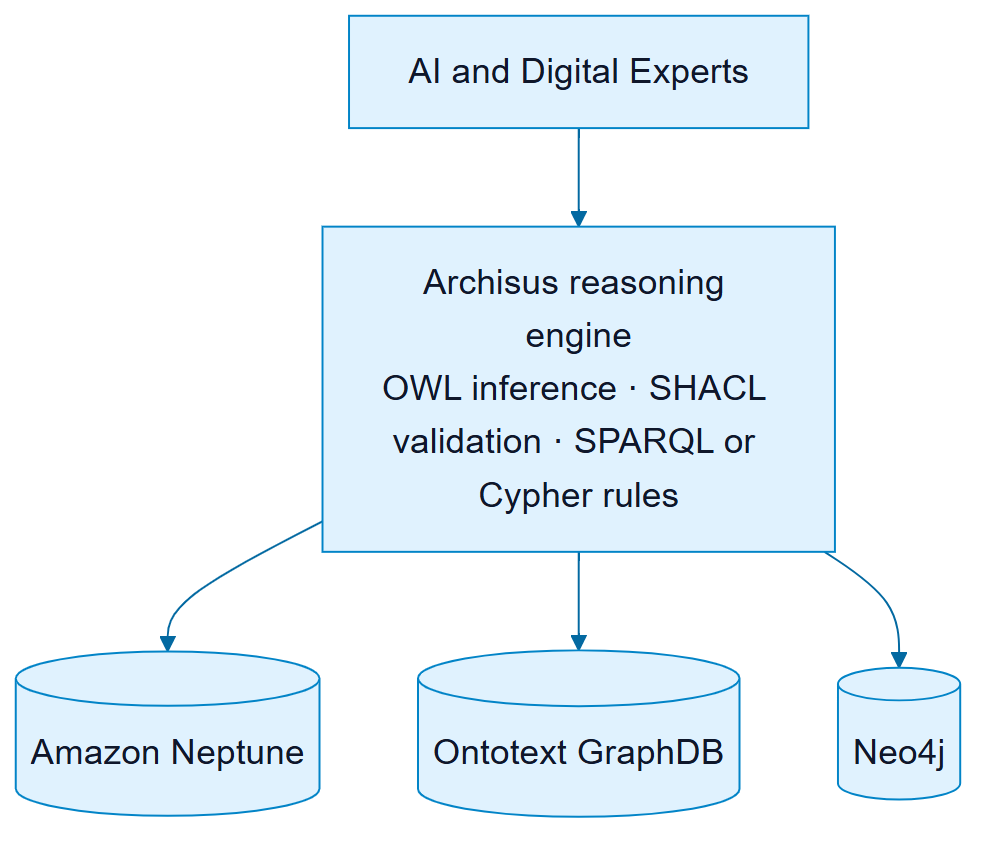
That's also how Archisus works: the knowledge graph is kept in the store you already use (Neptune, GraphDB or Neo4j), and the reasoning (OWL inference, SHACL validation and rules, SPARQL or Cypher-based rules) runs in the Archisus engine. The same rules apply whichever store holds the graph, so you can choose the database that suits your infrastructure and team rather than the one a vendor requires.
More detail is on the platform page.
The short version
- Already on AWS and want low maintenance? Neptune.
- Ontology-led, rule-heavy, or must run on your own infrastructure? GraphDB.
- Developer-led, analytics-heavy, or want the largest ecosystem? Neo4j.
- Whatever you choose, invest most in the model of your business, because that's what lasts.
Not sure which fits? The Archisus Business DNA Audit maps one domain in two weeks and includes a recommendation for how the graph should be stored and governed in your environment.